
Words by Annie Barber.
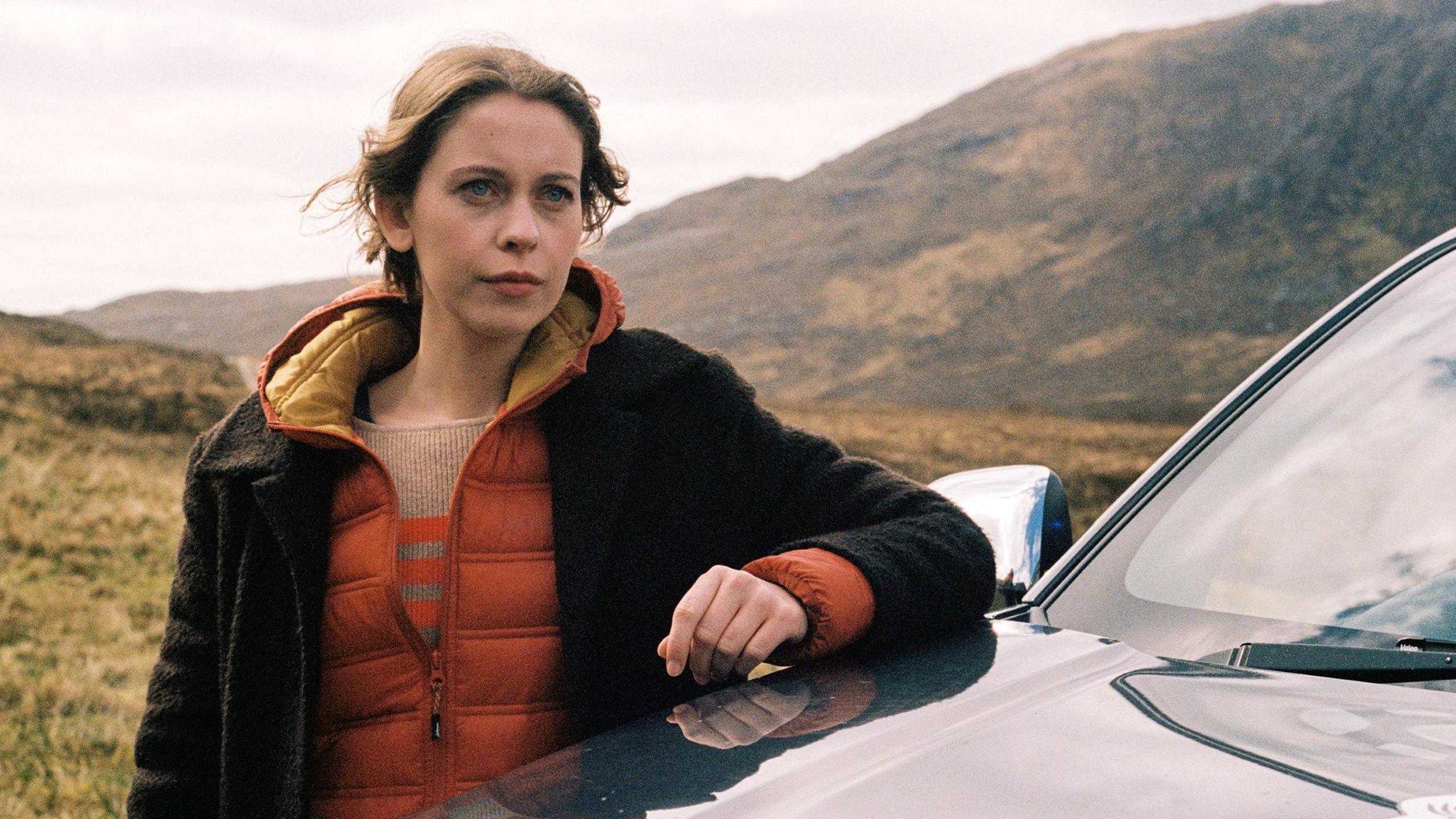
Born and raised on the Isle of Lewis, Sorcha Groundsell is using her career to spotlight the rural Scottish culture which she grew up surrounded by. Her latest endeavour is the TV show ‘An t-Eilean’, which means ‘The Island’ in Gaelic. Scripted mainly in Gaelic and partly in English, Sorcha plays the protagonist, a police officer by the name of Kat, who returns to her home island, the Isle of Harris, to investigate a murder. Sorcha sat down to talk to Karma! about island life and the importance of uplifting rural communities.
AB: Do you think that growing up on the Isle of Lewis, or living in Scotland more generally, influenced your career in any way?
SG: I’m sure it has. It’s definitely influenced the things I’m interested in… I’ve played a lot of characters that have some kind of Scottish or Celtic connection. Just to go really philosophical about it, I think in the islands, there is a sort of slightly other-worldly feeling in the air that then bleeds into your experience as an individual, which I think lends itself to, genre, for example, pretty well. If you’re working in fantasy, I think you probably do naturally gravitate towards things that have that sense of other-worldliness.
AB: I think that makes a lot of sense, I definitely agree with you about the other worldly vibe. I don’t know if you’ve heard about this book, it’s called ‘Soil and Soul’ by Alistair Macintosh – it’s one of my favourite books. When I read it, I was like, “this fits so well with my experience of the island!” I think that connection to nature which the book explores is something that a lot of people, especially those growing up in urban areas, don’t have. Also, living on the island is a very spiritual experience, I think, which is often overlooked.
SG: Yeah, and I think it can be so important and so impactful. I think it’s a connection to nature, but it’s also a connection to time and history and tradition and community. I mean, obviously really tight-knit communities are all over the world in all different kinds of cultural setups, but I think the sense of community and its value is so prevalent in the islands, partly out of necessity, right? Like, you have to be a bonded community there, because you rely on one another so much. I think that grounding of a baseline of knowing that you are a participant in a wider collective is an interesting basis for life.
AB: What was your experience of breaking into the acting industry like?
SG: My experience was not textbook. I have occasionally been asked for advice on how to break into the industry, and I have almost none to give because it was such happenstance for me. I got very lucky straight away… I think if you go the traditional route [of going to drama school], which I was planning to do… you get a really specific and, I’m sure, incredibly valuable educational insight by going that route. However, if you go this other route, which I kind of accidentally ended up doing, there is such incredible scope to learn that way too; to learn from the people that you’re working with and the actual professional experiences you have. So I suppose that’s the thing that I’ve tried to take with me from those early experiences, an openness to learning from whatever situation you find yourself in.
AB: You’ve starred in other films and TV shows that are set in Scotland, such as ‘Iona’ and ‘Shetland’. Do you think that it’s important to represent remote communities in the media?
SG: I do think it is important. I have become increasingly aware over the years how important it is, certainly to me, and, I think, how important it is to the wider culture. In the course of reading a lot of scripts – which you do, after 12 years of doing this job – I have become very aware of the narrow variety of viewpoints from which these things are being written. That’s not to say that [those viewpoints] doesn’t have value – they do – but that can’t be the whole picture. [While] doing this Gaelic series, we’ve been talking a lot about identity, not particularly as actors or as filmmakers, but for all of us as individuals; how we feel about ourselves, and the capacity we see in ourselves, and the possibility we see for our own lives, [which] I think, is so impacted by media. If we don’t see ourselves or anything of ourselves represented in any form of media, we’re not going to feel like we really exist in the wider world. I certainly felt that coming into the industry. I didn’t know anyone who was an actor and there weren’t really any visible actors from the island that I was aware of at the time. I think it did create this sense that I needed to change a lot about myself in order to have access to this world, like I needed to reinvent my myself and my identity to fit this very southern-focused image of what acting is like in the film industry. I think that it is useful to be able to mould yourself, and it is sometimes necessary, but I think it closes you off to to what you have to contribute… I’m not going to get into a whole big, soapbox thing about why it matters from a socio economic standpoint, but it does!


AB: So there’s two things in there that I want to pick up on. Firstly, I’ve seen people saying that ‘An t-Eilean’ is merging traditional Scottish/island culture with a modern storyline. What do you think about that? Was it hard to balance the two things, the traditional culture and the contemporary viewpoint?
SG: That’s interesting that you mentioned that, because that’s something that I’ve heard a lot from people who don’t have Gaelic or island connections. Even in a practical sense, the switching between Gaelic and English, people were really struck by the naturalism of [it]… I think, in a sense, the value of what you’re talking about within the show is, not so much creating something new by putting those elements together, but it’s exposing already existing Gaelic culture to the rest of the world. Like that combination of deep traditional beliefs and really contemporary living, that’s just our experience as people from the islands… So I think, in a way, it was just sort of articulating what people’s experience is, for the most part, [which] certainly wasn’t a difficulty for us. I think a lot of the value of that came from the writing itself. That was an interesting product of an English writer working with an island origin, Gaelic writer.
AB: It’s not as behind the times as everyone thinks, in a way – it’s sort of helping to bring the island culture up to speed with everyone else, not from the island’s perspective, but for other people; it reminds them that it’s not super far away from what they know themselves, which is good.
SG: And that it is more than just a beautiful postcard, [or an] empty tourist destination. Part of what was so thrilling about making the show was this sense that there is a thriving community in the islands… It has not been made easy for the islands to thrive, but there is a thriving culture and industry there. There are incredibly talented people, there are incredibly ambitious and energetic people who want to participate in the world’s industries, and are participating, [but] it just has not always been noticed from a film industry perspective. Scotland has been a really popular location for other people to shoot in, but that hasn’t always come with opportunities for local people. I think what was so moving to me in making the show was seeing those people, these island based, island origin (a lot of them Gaelic speakers) crew members and artists and creatives of all kind, who are so skilled and so committed and so ready to make use of this opportunity; that actually there is such value there. So it’s about time that it was acknowledged.
AB: Yeah, that’s true! As you’ve mentioned, the show is mainly in Gaelic. Do you think that TV is a good tool for reviving Celtic languages, especially for younger generations?
SG: Yeah, I do. I mean, we consume so much of it, it makes up such a big part of our kind of collective cultural experience that I think it is a really useful vehicle for that message and that objective. And I think there’s such an openness now in the arts generally, but particularly in TV, to explore unusual perspectives. We’ve been mentioning over and over again the Scandinavian shows, but that is a really apt example; I don’t know anything about what life is like in northern Sweden, but, there was a TV show about it, and therefore I can have access to that world and that culture. I think people are really interested in that.

AB: I want to turn next to ‘Seaforth’, the independent film that you’re producing and starring in. How did it come about and what can we expect from it?
SG: Basically a writer, director, very talented friend of mine had written the script, and while we were working together on ‘An t-Eilean’, I got involved in the development, and then came on board as a producer. The intention of the film really is to make use of this really rich storytelling history and history of folklore. We have so much material in island cultures for incredible storytelling… The more business-minded focus of it was to get this collective of filmmakers together. Over the course of my friend’s time working in the industry and mine, we’ve sort of built up this like, old fashioned Rolodex of such incredible, talented people who are either from the islands but don’t live there anymore, or who are living and working in the islands. We wanted to create this thing that we could all do together that would not just provide opportunities for them and for us, but would be something that was really a labour of love for all of us, and reflected what this cohort of up-and-coming island talent is capable of.
AB: That makes sense! So this one might be a slightly trickier question, because of what you said earlier about not wanting to give advice… Are there any ways you think access to the arts can be improved for isolated locations like the island?
SG: Well it’s so tricky, because at the end of the day, it always comes down to funding… I think in a time of financial difficulty, it’s really easy to underestimate the value of the arts and to to funnel money away from the arts. I completely understand why people feel that way, but I do think that there is plenty of evidence to suggest that access to the arts improves quality of life… Beyond that, I suppose it also then connects to that sense of identity and self worth. I think the more things we can see that reflect the possibility for island arts and Gaelic arts, the more empowered, hopefully, people will feel to participate and to opt in in that way. It sounds a bit like high and mighty, but I’ve had so many messages from people, mostly Gaelic speakers, off the back of the show, feeling really inspired by it, and wanting to get into the arts, and take up the mantle of preserving and protecting Gaelic… I think those who care about it just need to keep trying to find ways of of pushing and promoting and uplifting it.
AB: I think that’s very important, especially in the age of social media. People jump on trends a lot more and traditional cultures are getting left behind. So, we ask all of our interviewees the next two questions. The first one is: if you or your art were a colour, what would you pick?
SG: Ooh… I think it’s probably quite predictable for a Gael who grew up by the sea, but I feel like it would be an aquamarine blue.
AB: I can see that! The last one is: can you give us a song recommendation that we can add to the Karma! playlist?
SG: I feel like the only thing that I’m going to be able to think of is what I was listening to on my run this morning, which is slightly left field… My favourite song at the moment is a song called ‘Trouble No More’, by the Allman Brothers Band. I don’t know why, but that’s the song in my head right now [she laughs].
AB: Okay, yep, fresh in your memory! I’ll give that a listen.
‘An t-Eilean’ is available to stream on BBC iPlayer now.


Leave a Reply