In one part of the world, people are fighting just to stay alive. In another, they’re gathering to celebrate it. So being at a festival with 65,000 people all wanting to celebrate life feels even stranger, almost contradictory. How do you deal with the privilege of celebrating, when you know, others are struggling to survive?
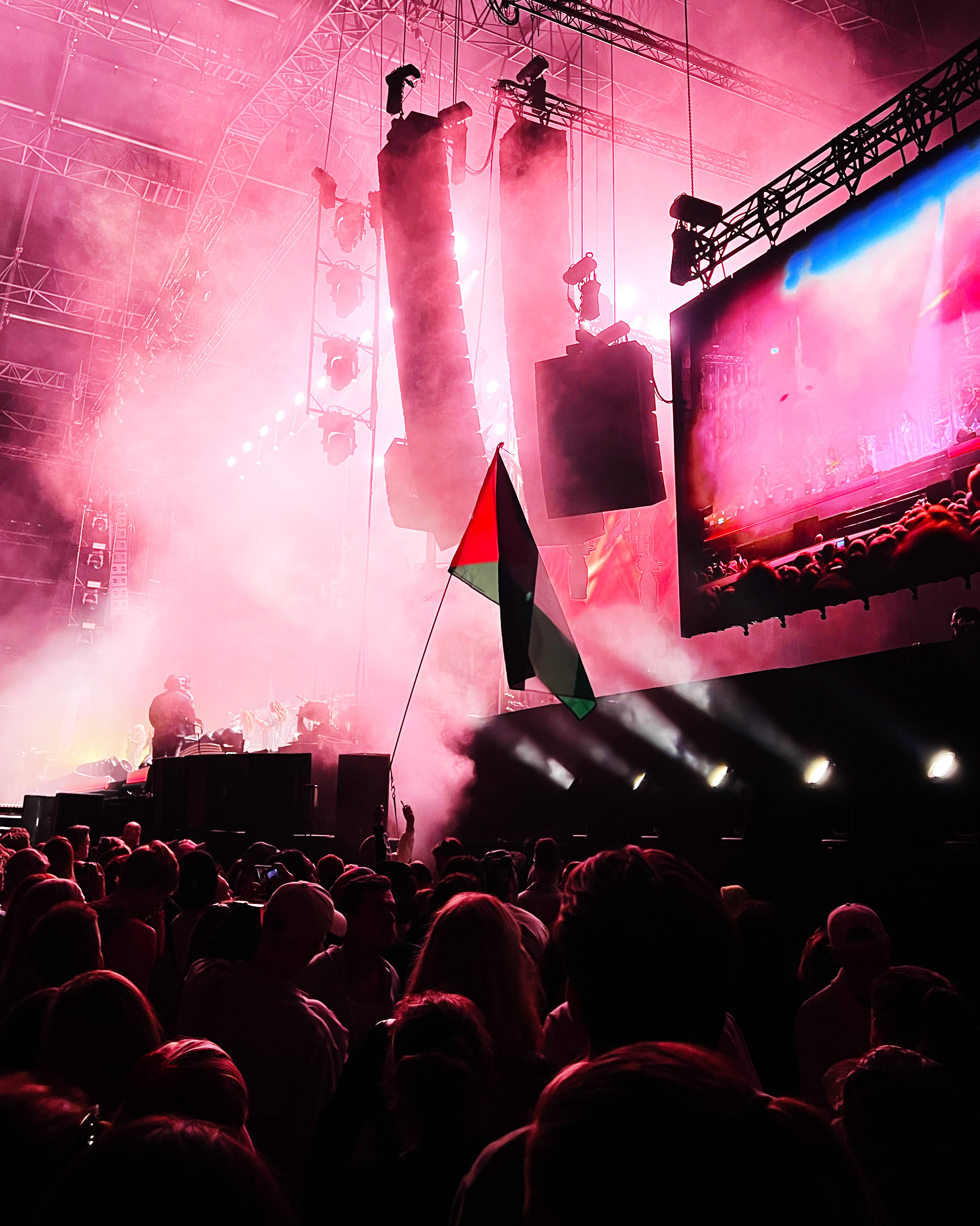
Lowlands proves it can be both a space for music and for protest. Everywhere, you are reminded of the weight of the world: Palestine stickers on bathroom doors and poles, slipped onto instruments and stitched into clothing, watermelon tattoos pressed onto the skin of festival-goers, flags waving through the crowds. It’s subtle and loud at the same time present everywhere.
Artists like Deadletter and Black Country, New Road used their sets to bring Palestine to the forefront. A strong feeling of hope and unity arrived when Fontaines D.C. claimed space with their final song. The lead singer spoke about Palestine and displayed across the screens the phrase: “Israel is committing genocide, use your voice.”. The crowd erupted and Palestinian flags went waiving from left to right. A collective release, the joy of recognition, and a feeling of unity flood over the crowd. The crowd cheered for the band while screaming Free Palestine.
Lowlands proves it can be both a space for music and for protest.
At first glance, everything at Lowlands radiates joy. Music echoes from every direction, food stands are bursting with life, and laughter is everywhere. However, when stepping into the tent where the talk “Optimism Without Hope” takes place. The mood shifts, It is heavy and emotional, but necessary. Every day Lowlands dedicates an hour to talks where speakers shed light on the alarming state of the world. That Friday afternoon, between 600 and 800 people gathered to listen, to absorb the stories and insights of experts. Out of more than 65,000 festival-goers, that’s just about 1%.
And so begs the question, why only 1%?

On Friday, Stryder opened with a powerful spoken word piece, setting the tone for the talk.
Lowlands director Eric van Eerdenburg also joined the discussion. He acknowledged the challenges of booking certain artists, as some were banned from preforming. He also spoke candidly about the financial balancing act of running a festival. Sponsors make the scale of Lowlands possible, even if that comes with limitations. Still, Eric stressed that protest and activism only gain traction when they’re given space by larger platforms. It meant a lot that he opened the space for change, for dialogue, and for the energy we all felt and witnessed at Lowlands. As he put it, “It’s a fusion of energy that carries on into the real world.”
Then came Dr. Salih El Saddy. The moment he began speaking about Palestine, the room fell silent. His words were heavy, unflinching. And the pain was tangible. He described Gaza’s collapsing healthcare system: hospitals bombed daily, surgical units burned, patients left to die under rubble. Though the facts weren’t new to many, hearing them spoken aloud, raw and direct, they cut deep. People cried openly. Others reached out to hold strangers’ hands. And when it ended, the room rose in a standing ovation. It almost felt relieving seeing all those people cry and to witness that level of care, that collective grief, in a space where people could easily choose to look away.

On day two, a man with a beer in hand stumbled into the same tent, likely hungover, possibly just curious. However he stayed, and that mattered. On the other side of the tent, the weight of another war took centre stage. The day before, Trump and Putin had publicly debated Ukraine’s future, as missiles continued to rain down on Ukraine.
Vita Kovalenko took the mic, sharing how her worst fears had become reality. While world leaders play political games, real lives are being lost. Missiles don’t wait for ceasefires. Drones do not recognise negotiations.
Raimond, a former goalkeeper now coaching football in Ukraine, spoke next. His voice wavered as he described life there, training kids while explosions echo in the distance. He finished his story, tears and all.
Outside the tent, the basslines thumped and music carried on. Inside, reality settled in—a different rhythm, one made of grief, urgency, and courage.
Constantly we’re reminded of how important it is to be present, to talk, hope, and to do everything we can to not be silenced.
The closing words linger: “When you come out of this room, and you start dancing again, remember: you’re dancing in freedom’.
It feels conflicting, one moment you are in tears, hearing about people suffering and dying; the next, you’re dancing under the open sky, swept up in music and joy. You find yourself wondering which act to see next, where your friends are, whether you’ll make it across the festival grounds in time for the headliner. That contrast can feel unsettling, but maybe that is exactly why awareness matters so much.
Festivals like Lowlands, with platforms as wide-reaching as theirs, have a responsibility, and an opportunity, to make space for protest, to amplify voices calling for change. Because staying silent isn’t neutral; it’s a choice. Even when a small fraction of a crowd, say, 600 people, stand together with intention, they keep the conversation alive. They remind us that change is possible, that hope still exists.
We must remember: freedom is not a given. We can dance in freedom, we can hold each other in freedom, we can cry in freedom, and we have the choice to think about war in freedom. And in that same freedom, we must choose to remember, to speak up, and to care.
Written by Demi Nankman
Photos by Julia Bootsgezel
Leave a Reply