Written and photographed by Emma Edwards
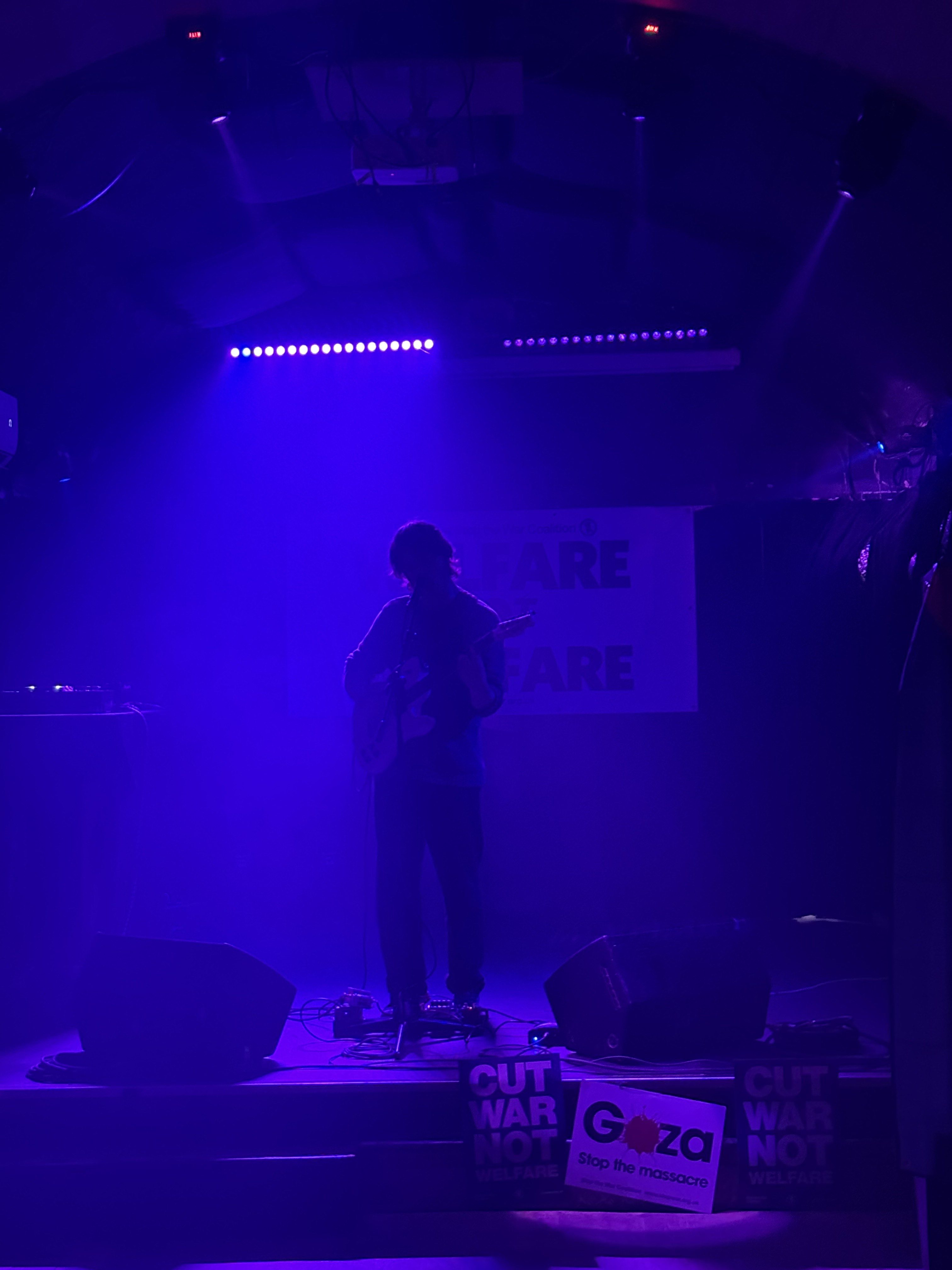
In ‘Stereo’, ‘No A Mean City III: Kindness as an Act of Resistance’ assembled a line up of Glasgow based acts to reflect the talent, diversity and goodwill at the heart of the city’s grassroots music community. The crowd pressed together, shoulder to shoulder and sang along to a selection of noughties covers. The evening raised £4933.35 for Refuweegee, a community led charity set up to aid for displaced people arriving in Glasgow.
This convergence of art and activism is all over Glasgow; from Stop The War Scotland’s aid gig headlined by Declan Welsh, to Son of the Right Hand’s single ‘Refuweegee (This House Isn’t Full)’, the impulse towards connection runs through the music itself. Welsh has long been among Glasgow’s most outspoken songwriters. For him, the relationship between art and politics has always been uneasy.
“You’re going to get pigeonholed as a political band,” he said. “But you kind of have to not care. If you feel like saying something, then do it.” His response points to what popular music scholar Simon Frith observed about performance: it doesn’t simply mirror social values, it constructs them. When an artist speaks politically in an industry that discourages it, the act itself becomes meaningful.
Welsh resists the idea that political expression must be explicit. “You don’t need to say it explicitly for something to be political,” he said. “Sometimes you can say something very explicit that kind of doesn’t do anything.” The distinction recalls Frith’s claim that performance is where music becomes social theory in action, a space where equality, empathy and resistance can be enacted between performer and audience. When asked what connection means on stage, Welsh described it as “all of those things: energy, empathy, honesty. The idea of connection is fundamental to what art does.” He continued: “Live gigs remind you that every human being has the same set of feelings to draw from. When we all bond over art, it’s amazing that this human thing, to feel and live and exist, can be described through sound.”
Musicologist Christopher Small’s concept of musicking helps explain why this is important. Meaning emerges not only from songs but from the relationships created through performing, listening and moving together. In that sense, connection is political not because it declares an ideology but because it constructs relation; it makes sociality audible.
Welsh’s understanding of art has changed over time. “Before, I was much more like, ‘functional art should do this thing,’” he said. “Now I’m a bit more ambivalent about art having to have a specific purpose.” He is wary of moral grandstanding. “It’s a bit arrogant to assume a song’s going to change the world. A song shouldn’t attempt that.” Yet he is equally clear about responsibility: “If you’re meaningfully trying to get involved to make the world a better place, you can’t end at writing songs.”
That sentiment sits within a broader cultural conversation about art’s capacity to produce social change. Social theorist Jacques Attali argued that every musical practice prefigures a social order. Anthropologist Georgina Born later described music as a social medium that both reflects and organises collectivity. Welsh’s perspective grounds those ideas in lived experience. He recognises art’s limits but insists that participation in solidarity work, unions or direct action gives artistic expression its weight. In this context, theory meets material practice. Glasgow’s creative networks translate the abstract politics of sound into lived infrastructure; mutual aid, union membership and collective care. The scene turns cultural labour itself into a mode of organisation, reasserting that the social value of art lies less in what it represents than what it enables.


Glasgow’s creative left continues to test the relationship between sound and struggle. Son of the Right Hand embodies it in their single ‘Refuweegee (The House Isn’t Full)’, which samples chants from the 2021 Kenmure Street protest, when hundreds of residents surrounded a Home Office van to prevent the deportation of two of their neighbours. The chants are interwoven with bagpipes and reverb into a sonic document of resistance, mirroring the events of that day. Benjamin Stewart, who sings and plays guitar, told me the song took time because “there was a lot of weight to that day, the resilience was unbelievable.” Éireann Sheridan, the vocalist and keyboardist, added: “Bagpipes were always the right choice. They’re ceremonial and communal but also militaristic; they totally represented that sense of protest as well as belonging.” The track captures what Born calls music’s social ontology, the way sound carries community within it. The pipes recall folk traditions of mourning and defiance while grounding the protest in the city’s own sonic history. Rather than documenting an event, the song enacts it again each time it is played.
For Welsh, solidarity also means confronting the pressures that shape expression. “If you talk about certain things, your audience gets held hostage by social media companies until you pay them money to advertise to them,” he said. “There are consequences for that. There doesn’t have to be, but there often is.” The comment echoes recent cultural industry scholarship which treats digital platforms as gatekeepers of cultural discourse, systems that commodify dissent.
Despite those constraints, Welsh sees genuine commitment in the grassroots. “Younger bands and DIY bands have been pretty good at trying to raise money and say the right thing,” he said. “People with kids or mid-to-upper-level acts, whose income depends on it, maybe less so, but the will is there.” He values that will even in disorganisation. “We’re a disorganised group of people that just make stuff. Unlike nurses or firefighters, we’ve not got a history of how to use our labour to make change. Hopefully we can learn that.”
That aspiration, learning how to organise through art, resonates with Tia DeNora’s notion of music as a “technology of the self and society,” a way of turning emotion into coordinated purpose. It also aligns with Raymond Williams’s idea that cultural forms carry the emotional knowledge of social change before it becomes political doctrine. At No A Mean City III, that connection was palpable. Between sets, the audience also heard speeches from Declan Welsh and Selina Hailes. The atmosphere was serious but joyous, defiance met with care. As the night ended, the audience swayed and sang together without prompting. It wasn’t a protest anthem so much as a quiet reminder of collective connection.
Glasgow provides a rich empirical site for examining these dynamics. Son of the Right Hand’s Sandy notes its long history: “Scottish protest music is unavoidable. It’s everything from ‘Flower of Scotland’ to ‘Cap in Hand’, it’s baked into our culture.” Her observation reflects the persistence of what Alec Finlay calls “radical hospitality,” a civic ethos of welcome and care that extends from community organising to artistic production. This ethos animates organisations like Refuweegee, whose public events combine creative expression with mutual aid.
Hailes sees that same principle at work in Refuweegee’s daily practice. Music, she explained, creates space for belonging before bureaucracy does. Early on, she learned that a shared experience, like taking new arrivals to a Barrowlands gig, could open conversation without centring trauma. “You’re just at a gig enjoying something together,” she said. “You’ve got that to talk about forever more.” For Hailes, that is the point: connection as safety, community as structure.
Music’s social ontology, as Born describes it, is what we hear when connection becomes audible. What emerges from No Mean City and its constellation of allied projects is a politics of relation, a belief that connection itself can be a form of resistance. In Glasgow, art does not simply represent solidarity; it rehearses it. Each gig is its own small rehearsal for the kind of city people want to live in.
Hailes put it simply: “The No Mean City gig was exactly that, a collective sense of frustration and annoyance, but also hope. Hope, because everyone in that room was saying, nah, not on my watch. It felt safe. That’s what it is: safety through connection. The line between live music and activism is almost invisible now; they’re both about coming together, feeling seen, and finding power in community.”
Whilst leaving the gig, I reflected that connection was not just a feeling, but a form of organising. The groundwork of solidarity itself. In Stereo that night, connection felt material and alive. As I watched strangers sing and sway together, I saw what Frith and Born meant; music does not describe collectivity but performs it. Connection was not metaphor, but method. Moments like those serve as a reminder that unity is not an abstract feeling; it’s the result of quiet, deliberate shared labour, people building power together.

Leave a Reply