Written by Megan Henry

It has been over a month since Rosalía has released her fourth studio album ‘LUX’. The tone of this album is overall humane, including references to religion, mortality, love and virtue. Rosalía has been one of my top artists for the better half of a decade, her music seeing me through some of my most formative years. Her raw talent and intense love for the art of music is translated throughout an exploration of a multitude of genres throughout her discography. If you take the time to investigate her as an artist, you are immediately shown how intelligent, grounded and honest she is, especially when given a chance to speak about her artistic method and inspirations during interviews.

In a recent conversation with Zane Lowe, Rosalía gives rich emotional insight into the making of ‘LUX’, describing how her previous project ‘Motomami’ was minimalism, but ‘LUX’ is maximalism. Rosalía shares different mantras she used, such as “stretch the bow and speak the truth”, a rough translation of a phrase she had inscribed onto a mug. ‘Lux’ is the Latin word for ‘light’, and she shares the idea that “cracks are where the light comes in”, speaking to how something ugly and inconvenient can also lead to an idea that is outside of our normalcy. Rosalía describes how the blurry line between what is personal and universal inspired her as the foundation for the album. She stated that she wanted to pursue intention and completion in this project, where before she had been “making songs but not finishing the thought”. Other interesting facts she shared are that there are no loops in the album, everything is played out and sung from start to finish, solidifying her determination in creating such a human piece of art.

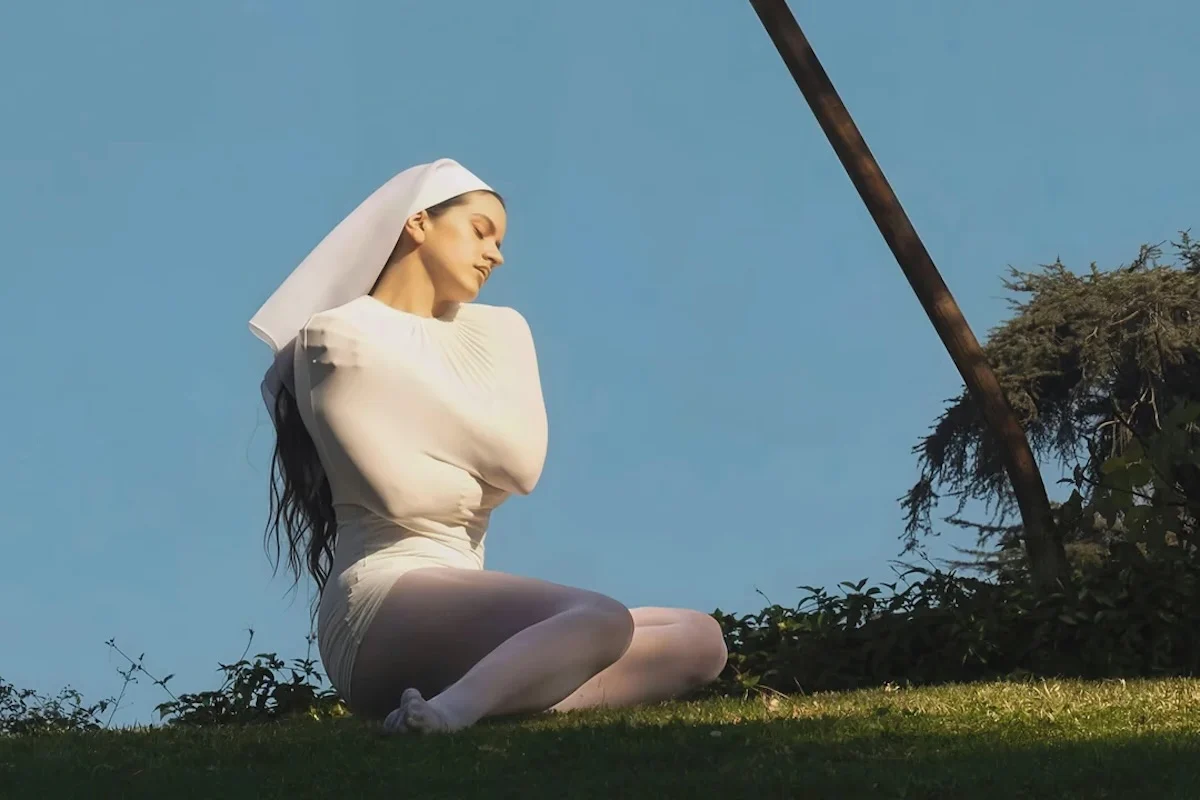
As almost every female artist does, Rosalía has entered a new era with this project. She is visually presenting the motifs of her album through fashion and images released alongside the music as promotional assets. These accompanying visuals are in full force for ‘LUX’, influencing audiences to follow a romantic and saint-like creative direction. The cover artwork for the album holds that creative essence, photographed by Noah Dillon and styled by Chloe and Chenelle Delgadillo. The minimal image shows Rosalía turning towards the light with eyes closed, wearing a restrictive Alain Paul dress and accompanying headpiece that resembles a nun’s habit.

The music video for the album’s lead single ‘Berghain’ is as creatively striking as the song itself, and the fashion dives into a handful of archival 2000s pieces. The stylist for ‘Berghain’ was Jose Carayol, assisted by Misha Davis and Helena Contreras. Carayol sourced a collection of vintage Alexander McQueen: Spring’03 rosary sandals, a button detail tank from the same collection and a Givenchy by McQueen Fall’97 wrap-around scarf top. Towards the end of the video, Rosalía wears a Balenciaga Spring’04 pink tunic, paired with a red hair ribbon in a scene reminiscent of Snow White. Another identified piece is the Rave RVW Spring’26 apron dress worn as she completes household chores, surrounded by the orchestra that lives in her mind.


‘La Perla’ has been the second music video released, directed by Stillz and styled by returning collaborators Chloe and Chenelle Delgadillo. Rosalía wears a multitude of defensive sports gear, including a fencing outfit, an ice-hockey uniform and a padded dog-training suit. These looks match the theme of the song, needing to be protected, strong and defensive against a toxic partner. We cut between these guarded outfits to a contrasting modern streetwear look, featuring Dior sunglasses, a Nicklass Kovgaard cinched hoodie and a chastity belt peeking over black low-waisted joggers. The chastity belt was designed by jewellery brand Other People’s Property, a custom sterling silver and lamb leather piece that appears as the most striking accessory in the video, as well as Rosalía’s new bleached hair halo.


The beauty of these still images are accompanied by their unique ability to connect to the corresponding music. In Berghain, these images connote feelings of anxiety, pressure and adrenaline. Rosalia is visually battling something that is physically surrounding her as much as it is mentally. In comparison, images from La Perla portray how Rosalía has the freedom of being alone, taking defensive control as she floats around on the rink or drives her car with a look of liberation. The sound effect of a blade being drawn is used here in La Perla as well as a song from a previous album ‘El Mal Querer‘, both examples being a key story telling moment that is represented here with the visual aid of fencing.
With the wave of divine-like styling continuing, I’m looking forward to what creative direction Rosalía will take on her upcoming tour. Until then, all we can do is stream ‘LUX’ and walk around town with our own imaginary orchestra following us.
#LUX

Leave a Reply