Words by: Tee Tolmar
Fenne Lily and I begin by talking about where we’re from. Both of us are technically from London, although neither of us is quite from London; it’s just easier to say. She has been living in Brooklyn, New York, for the past few years and when she tells Americans she’s from London she says it registers in a way that naming her actual hometown wouldn’t. There is something fitting about the conversation beginning with this small negotiation of identity, since much of Fenne Lily’s new record was made while she was working out what parts of herself could travel with her, and what she might have to leave behind.
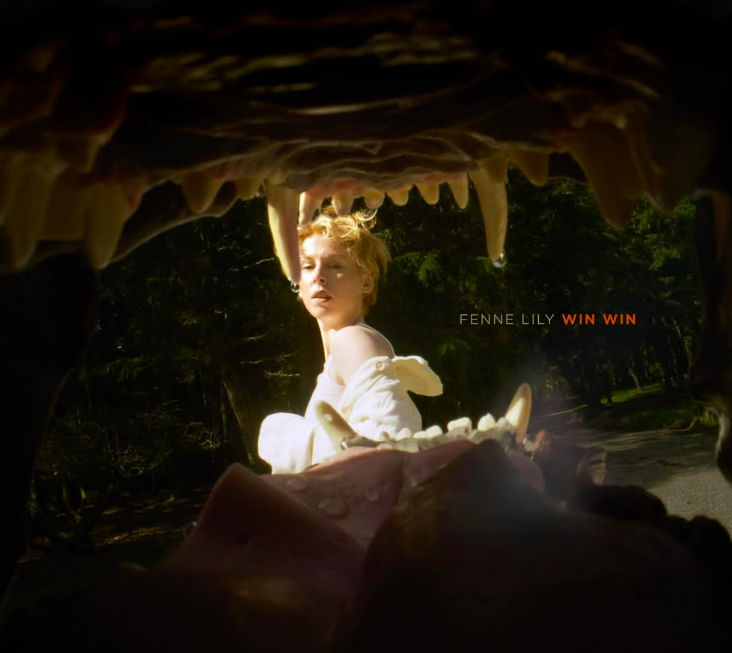
The record came out of a period of considerable upheaval. Fenne Lily had moved to New York, moved house several times, fallen in love with someone new, and was still trying to work out how not to carry the pain of a previous relationship into the next one. “It was kind of like boxing stuff up and unpacking it, in every sense,” she says. She admits to a slight regret – that she made the record too much about what she was moving on from – but there’s little sense of being trapped in the past when she talks about it now. If anything, she seems pleased that the songs retain some of the joy she was chasing while she made them.
“I wanted to make something that didn’t feel as lonely as that period felt,” she tells me.
It’s a simple explanation, but a telling one. Fenne Lily has spent much of her career associated with sad music, though she’s never been especially interested in sadness for its own sake. When she’s depressed, she doesn’t want music that leaves her alone with her thoughts. She wants something that feels full, with enough happening inside it that there’s no room to map every lyric onto her own life. On this record, she wanted the instrumentation to offer the kind of company that the period itself hadn’t.
The record wasn’t planned. Fenne Lily had only recently released her previous album when heartbreak arrived unannounced. Writing became a way of giving herself something to do when she couldn’t do much else. She describes not eating properly, drinking alone, even going running drunk, before gradually finding her way back through songs. Then, as life changed again, she began writing about falling in love with someone new. For a while she was effectively writing two records at once.
It was only around six months after the breakup that her friend Sam pointed out she might actually have an album and, by then, she agreed. She began recording almost as quickly as she was writing and, rather than deciding what the record should be before making it, she let it take shape alongside her life: “It just fell together as life happened.”
Fenne Lily had always assumed the emotional patterns in her music came from whatever circumstances she happened to be in, but moving to New York taught her that her loneliness ran deeper than any one place. One song, ‘Room to Room’ is about a dog losing its companion and realising it will be alone for the rest of its life, though Fenne Lily recognises it plays like a breakup song. “I think I see all loss as the same,” she says. “Every loss has the same depth for me.” She’s come to accept that loneliness may always be part of her, rather than something another person can resolve. She’s now in the healthiest relationship she’s ever had, but no longer treats being with someone as an escape from that feeling. “I have always felt really lonely, and that is actually not something that I want to fix,” she says. “I’ll always be lonely, no matter who I’m with.”
That acceptance has changed the way she thinks about songwriting too. She used to see writing as a way of processing emotion; now she thinks of it more as a way of discovering things she didn’t know were there. She picks up a guitar, finds some chords, turns on her voice recorder, and sings whatever comes into her head for half an hour. Listening back, she’ll sometimes realise she’s been singing about something she’d never consciously considered — her mum or details of England. She’d never thought of herself as homesick, but perhaps homesickness shows up in smaller forms than she’d imagined. “Whoa, maybe that’s something I should be thinking about,” she says, “because I’m clearly feeling it.”
This instinct carried into the making of the record itself. Rather than deciding in advance which instruments a song needed, Fenne Lily was more interested in what could be built from whatever was already in the room. A banjo became something resembling plucked violin strings. A fretless bass sounded like a singing saw. At one point she wanted a particular trumpet sound and discovered it didn’t need to involve a trumpet at all. “You can kind of do anything,” she tells me, “if you have people that are better than you at music in the room with you.”
Fenne Lily recorded the album with live tracking — as she has on her last three albums — with musicians playing together rather than building each song in isolation. The studio was the ground floor of a brownstone: a large living room and guitar amps set up in the kitchen. She likes the feeling of musicians responding to each other in real time. “It’s like we’re all sitting on a porch,” she says.
That craving for connection sits alongside a need for quiet; something New York has made increasingly hard to find. Before moving, Fenne Lily wanted the energy of a city where there was always another band to see, another show, another musician passing through. Then she arrived and discovered there was such a thing as too much inspiration. “As a consumer, it’s the perfect amount. As a creative, it’s overwhelming.” She laughs admitting that whenever she sees a good band, she wants to be that band. Eventually, she found she could recreate some of the quiet she’d once taken for granted, particularly late at night once the city settles.
Now, she’s ready to get out of the house. Making this record has been an intensely indoor experience: writing, recording, editing music videos, replying to emails, existing in that strange stretch between finishing something and letting it exist in the world. She wants to tour, to play these songs to people, and finally let them arrive.
“I want to get back into the world,” she says.
For a record that began with Fenne Lily trying to find her way through loneliness, it feels like the right next step. Not an escape from being alone, but a willingness to see what might happen beyond it.



Leave a Reply