Words and photos by Annie Barber
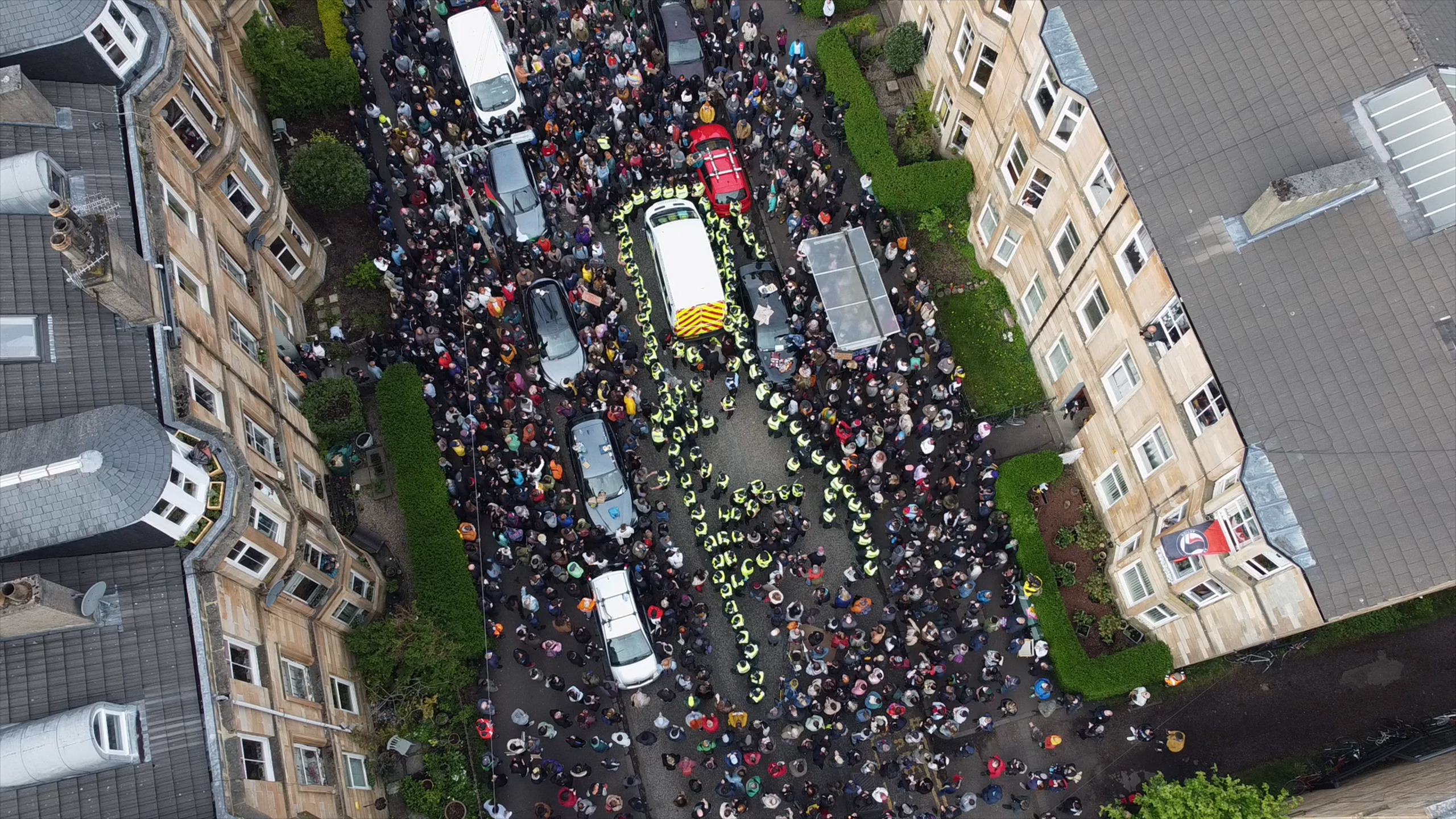
One morning in 2021, members of the community on Glasgow’s multicultural Southside found themselves abandoning their breakfasts and plans to go to school to attend a protest that would soon make headlines. Documentary film Everybody to Kenmure Street, which premiered at Glasgow Film Festival this week, tells the story of that day, one that many had previously thought unthinkable: a Home Office dawn raid on Eid al-Fitr, the Islamic celebration that marks the end of Ramadan. When two Sikh immigrants were detained by officers early that morning, word quickly spread and people came together, flocking to Kenmure Street, where the two men were being held in a van, to demand their immediate release.
Director Felipe Bustos Sierra paints a powerful picture of Glasgow’s activism, while also situating it within the city’s colonial history, exposing its dual and conflicting existence. The Glasgow Girls campaign, in which 7 girls stopped the deportation of their friend and ended child detention, is highlighted in the film, due to the campaign’s co-founder Roza Salih being present at Kenmure Street on that fateful day. Parallels are also drawn with the Govanhill baths occupation in 2001 in which the community rallied together to oppose Council plans to close down the facility. A historic moment in Glasgow’s history, the stunt marked the longest occupation of a public building in British history, lasting 140 days. These examples of successful activism are contrasted with scenes of the slavery and exploitation which helped to build Scotland’s biggest city.


Real life footage of the events that unfolded at Kenmure Street are spliced with historical footage, interviews with Glaswegians, and re-enacted scenes. This hybrid format gives the documentary depth and educational value, without making it feel sterile. At the heart of the film are the stories of those present on the day. Star appearances from Emma Thompson as Van Man, Kate Dickie as a selfless nurse, and Keira Lucchesi as a protestor, add an extra layer to the story. The trio play actual people who were present at the protest but did not want to appear in the documentary, thereby allowing their vital roles in the demonstration to still be told from their perspectives.
The stark reality of immigration enforcement officers and the police’s flagrant disregard for people’s safety and rights are laid bear in the film. It exposes several examples of unjust use of force, brutality, arrest, and deception. Police deployed around 40 riot vans and even a helicopter to what was a peaceful protest against the detention of two men who had been part of the community for a decade. The dystopian scenes displayed in the documentary drive home the systemic racism and harsh immigration policies which were at force in 2021, and are an ever present threat to the livelihoods of many who have made their home in the UK.


Human rights lawyer Aamer Anwar, who joined and negotiated on behalf of protesters at Kenmure Street, tells the tale from his own perspective, noting how remarkable and moving it was, with protestors putting themselves on the line to protect the two men. Mohammad Asif, who was also instrumental in the events that unfolded, contacted hundreds of people, including a number of MSPs who immediately got on the phone to the Home Office to plead with them. Yet all they were greeted with was silence. At 5PM, Police Scotland Chief Superintendent, Mark Sutherland, made the decision for the men to be freed.
The film arrives at a deeply troubling time in global politics, serving as both a warning and a beacon of hope. The demonstration brought together people from all corners of society — it was an intergenerational, interfaith, and interracial movement. None of the protestors had realised the impact it would have; each of them attended because they felt a moral duty to protect the two men (who were complete strangers to many of them). In a society that is increasingly fragmented, Everybody to Kenmure Street shows us how we can come together to counteract the rising right-wing and anti-immigrant rhetoric: using peaceful resistance and community solidarity.



Leave a Reply