Words by Natasha Clough
Photos: Nicole Ngai
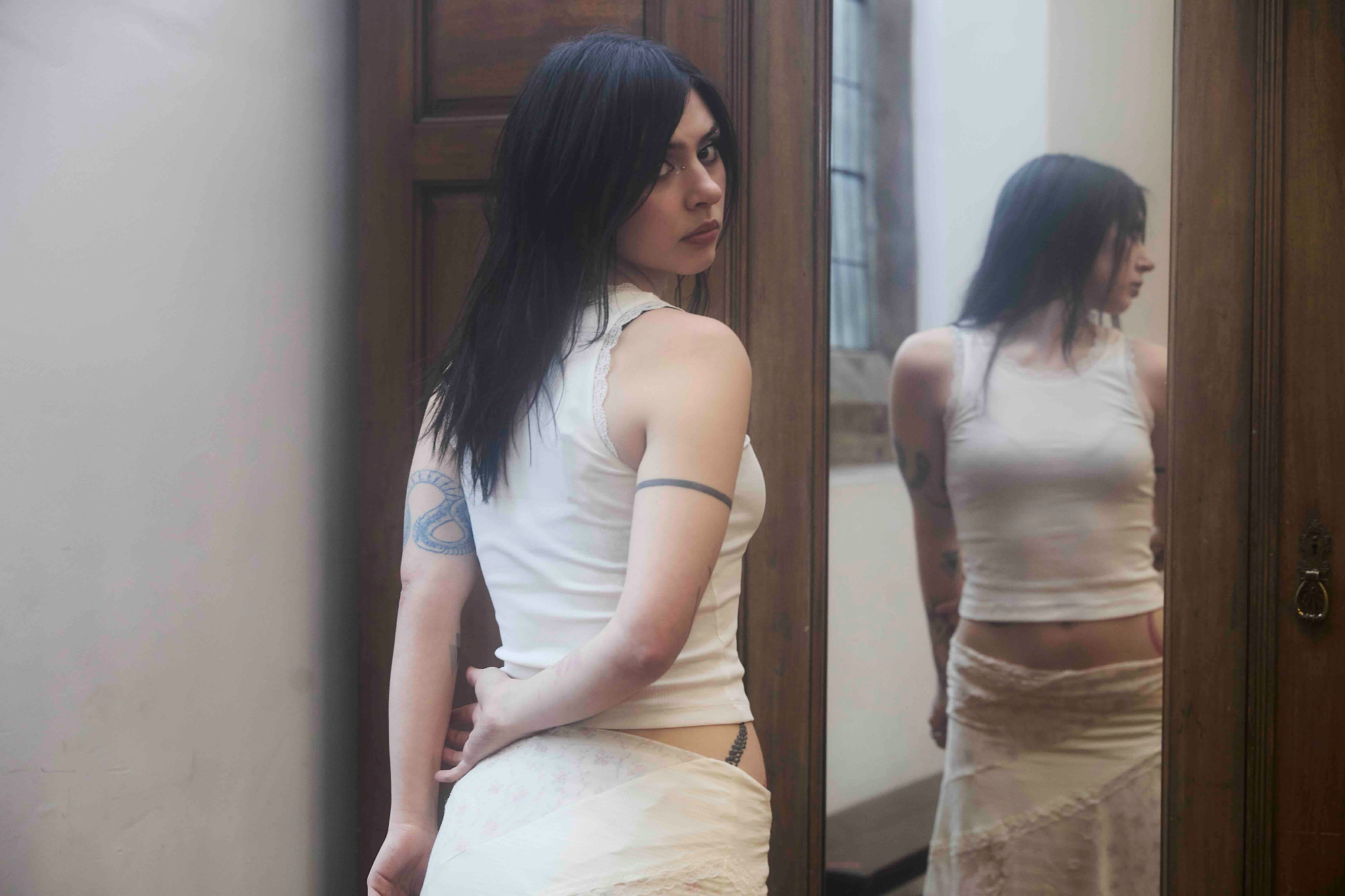
Imagine buying a baby pink towel, then washing it over and over again until the pink becomes sickly. This is how Brighton-based artist Lonnie Gunn would describe her music if it were a colour. In Gunn’s debut EP, 2013 horsemeat scandal, she conjures images of breaking pink butterfly wings, bellies full of mould, and baby teeth tied to a door. Across seven tracks, the singer delves into love, grief, codependency and self-sabotage. Bubblegum grunge was an earlier self-description of her sound, blending sugar-rush melodies with heavier guitar distortion. She tells me that this label doesn’t feel quite right anymore, failing to capture the darkness and vulnerability of this EP.
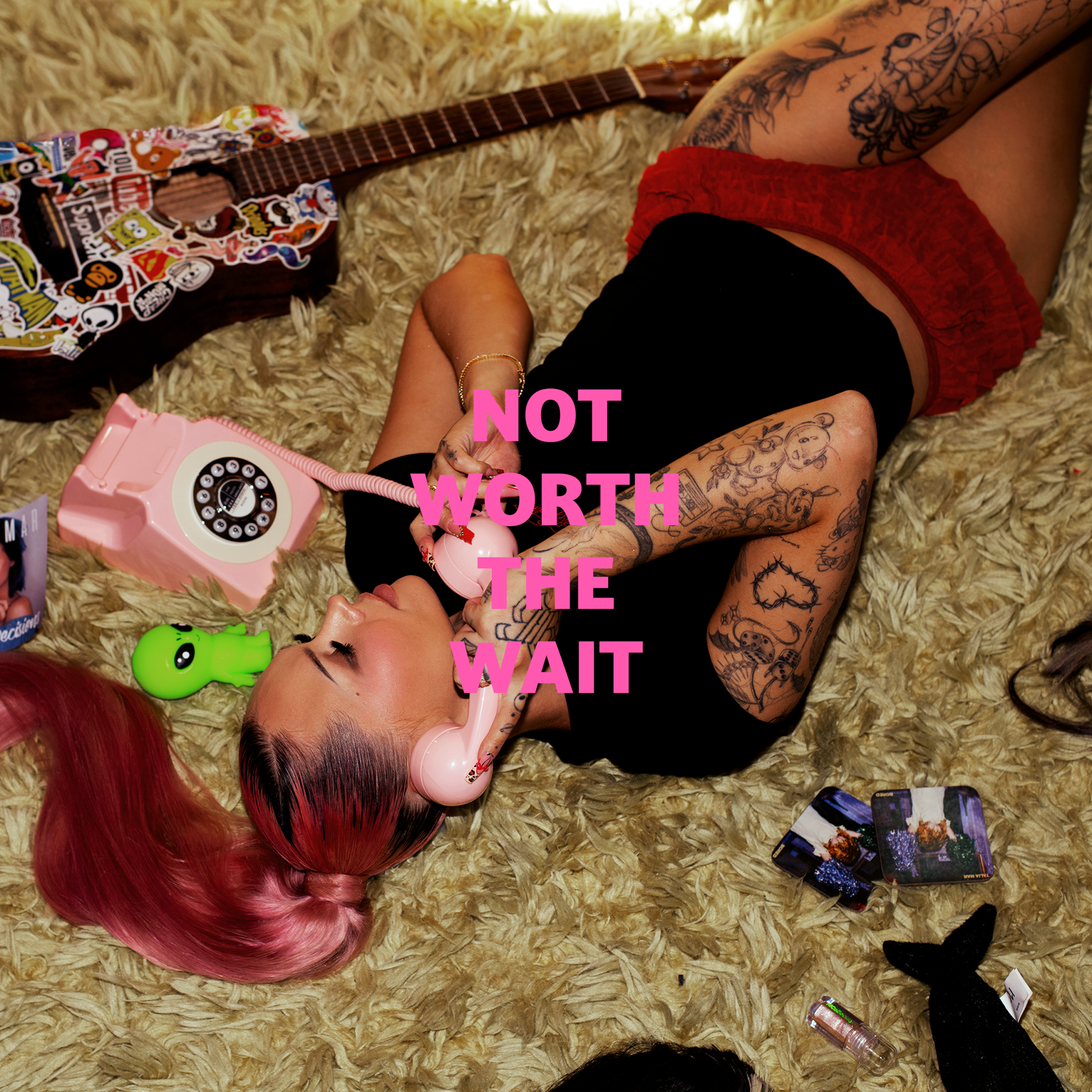
Many in the UK will remember the visceral horror of discovering our supermarket frozen burgers and lasagne contained traces of an unexpected animal. Gunn only learned about the event years later after moving to England from the States. A friend had joked that 2013 horsemeat scandal sounded like one of her song titles. It remained a note on her phone until, with time, it started to resonate in new ways. She began to feel like she could connect it to the tracks on her EP. As we talk about the project, she tells me that a lot of the songs have to do with feeling like an imposter in her own life; presenting people with a certain version of herself for fear that the real Lonnie Gunn might come across as “kind of gross or disgusting if they actually knew”.
Growing up in suburban New Jersey, Gunn had few distractions. This meant spending a lot of time in her bedroom: “I think that isolation and just watching the people around me and constantly being kind of a weird kid stuck inside my own head gave me a lot of fuel to write and work and create and also to try to live through other stories.” Movies and books played a big role in her youth and shaped the visual world her latest project lives in. “I’m sort of still paying tribute, and maybe eternally paying tribute to my 15-year-old self”: the things Gunn wanted to hear and see at that age and the ways she felt misunderstood by friends, romantic relationships and family. She needed a way to pass the time and started making songs about her feelings; then never stopped.
We soon get onto the topic of New Jersey music legends, My Chemical Romance: “I think it makes so much sense that they’re from here. Me and my sister were probably very similar to who they were as kids. My sister’s always been a comic book and video game nerd, and I’ve always been kind of a little emo kid.” As her childhood favourite band, Gunn loved reading stories about when MCR lived in her hometown, as it gave her a lot to relate to. She cites Gerard Way as a huge inspiration: “I think he’s done really well with his platform, which is all I can really ask of the people that are in my idols now … actually being caring, good and loving with their fame instead of wasting it, I guess.”
Music runs in the family. Gunn’s sister fronts the scum rock band Skintern. Gunn says, “She is terrifying on stage and so emotive. She’s just born for it.” A collaboration in the near future seems unlikely as Gunn tells me that, while she makes alternative rock, her sister’s sound is a lot heavier: “I think, oh, like compared to you, I’m so vanilla. She’s basically full-on screaming the entire time and she bleeds out of her eyes, like literally bleeds real human blood. So she’d think I’m a bit too soft. But I learned from her all the time. Every time I see her live, I learn to just perform and give less of the fuck about if I’m gonna look weird because she just really gives everything.”

The media and literature the singer discovered as a teenager never stopped shaping who she is as a person, and has a clear influence on the EP. Richard Siken’s poetry book, Crush, was handed to Gunn by her best friend during this time. The poems detail love, obsession, desire and violence – themes that recur throughout her songwriting. There’s even a direct line reference in the track ‘Taxidermy Swan’. “Whatever part of me it resonated with as a 16-year-old is very much alive and well inside me now,” she says. Growing up in the Tumblr era of the 2010s also led to a love for certain media. Films like The Virgin Suicides and Palo Alto found cult status in this space of the internet. Speaking on how it shaped her, Gunn muses, “I feel like Tumblr had this thing about it that was like everyone’s kind of a loser. I kind of miss that.”
The singer also loved “any movie where a group of high school girls murders people or a really weird, lonely girl goes and kills people. Basically, anything where a woman who’s lonely loses her shit. Luckily, I’ve never murdered anyone”, she jokes. The visuals of horror have worked their way into Gunn’s music. Think of camp 70s horror films like Carrie or the 2000s cult classic, May. She tells me that for this project, she really wanted to create something that felt like its own little universe. The video for the EP’s first track, ‘I Miss Everything’, places her at a saccharine party with baby-pink balloons, cake and strawberry milk. Alone, she begins to quickly spiral into destruction, singing: “I’m not bad, I’m not/I just lit a match/That burned down a house and all the people in it”. The video for ‘Babytooth’ acts as a sequel, showing the aftermath of party devastation reminiscent of a horror movie girl snapping. Through creating a distinct visual world for the EP, Gunn got to live through her earlier dream of working in film.
Gruesome imagery isn’t something Gunn shies away from in her music. Dead rats, slaughtered lambs, blood, claw marks and more appear, dramatising real emotions.
There’s a tendency to label women engaging with elements of horror as subversive or as trying to make a statement, but the singer emphasises the importance of the songs simply being honest about who she was and how she felt. “It is so normal and so universal, I think, as a woman, to be interested in gory, strange, scary things, and I know that that’s subversive because there is an expectation to be demure and softer and feminine and pretty but that’s so crazy to me because it’s so not new for women to be into gross weird shit.”
Gunn never felt like she was intentionally going against the grain. She tells me that ‘female rage’ has been applied to her music a lot too. “I’m just angry. Obviously, I am inherently a woman so, yeah, that’s part of it … at no point in my music was I thinking about a man or a man’s expectations.” If there’s any audience in her head, she says it would be her and her friends as teenage girls, and herself as a woman now, who “still feels like a teenage girl in some ways”.
Other women and queer people are who she has in mind with her music. The gruesome and gory is often something we’re already into; not shocking.
Gunn explains that she thinks that women, trans people and non-binary people are very attracted to the genre and find a lot of comfort in it: “It has to do with the dissonance of just existing and not ever really feeling like you match whatever expectation there is of you and that creates its own kind of scary feeling.” She goes on to explain that there’s little we’re told honestly about the experience of having a human body that’s growing and changing throughout our lives. “If you’re femme, if you’re a woman, there’s always this voice from a very early age that’s telling us to use our bodies in ways that aren’t necessarily in its favour, in ways that are a bit scary”.

The lyric visualizer for ‘Photocopy’ brings body horror to the forefront. Delicate white ribbon punctures the back of Gunn and her ‘photocopied’ body double, binding them together. It’s an image infused with abjection, the visceral discomfort of skin being pierced. This visual choice by the singer reinforces her belief that “bodies are strange and weird and they can hurt and they can ooze and they can be awful and painful or not look the way that you want them to or the way that other people want them to.” Horror becomes a way to work through some of those feelings and reclaim power. It’s no surprise that Gunn loved Jane Schoenbrun’s latest film, Teenage Sex and Death at Camp Miasma, a queer slasher that highlights the feeling of “a dissociative distance between yourself and your body”. She tells me, “Most of my friends just thought it was a sexy, fun horror movie, and it is. Or it can be this sort of like painful, introspective thing if you want it to be.”
I bring up the final song on 2013 horsemeat scandal, ‘glow in the dark star’. It slows down the EP from guitar-heavy alt-rock to an intimate, stripped-back track with haunting vocals: a perfect closer. It depicts how painful memories from an irreparable relationship come flooding back at first sight of them again. The song arose from a period of depression for the singer, becoming a way of saying that in a world that’s awful and bleak, there’s one little glowing light in the corner. “I’ll ignore everything, and I will keep digging myself this hole because I just can’t stop staring”. You can still see this person in everything. They never truly leave you.
Finally, we move to a staple Karma! question: a song recommendation for our playlist. She opts for ‘Slugs’ by Slow Pulp off their album Yard. “It changed the course of my life. I fell in love with it in 2023, 2024, whenever the album came out, and I think about it every single day; it’s my favourite.”
Gunn is set to play a Halloween show in Leeds, a perfect fit for her music. She tells me she definitely wants to dress up for it but fears her costume idea might get vetoed by her band. A new headline show at The Black Heart in London on 17th November has also been announced. She’s told fans, “I’m expecting a circle pit and a wall of death; no survivors”.
Leave a Reply